Recyclemadness
A friend of mine has recently alerted me to the latest brilliant idea for creating a more sustainable campus: organizing competition between various fraternities on who can recycle more. This seems to be just one form of recycling competitions that are sweeping US college campuses, the largest and most comprehensive one being the so called Recyclemania which purports to include over 550 colleges and universities. So what, aside from the dubious value of recycling in its own right, is wrong with organizing a competition like this one where young people can be given some incentives to do something valuable and "enlightened" while having fun? Well, lots of things. As my friend pointed out, these sorts of competitions create all sorts of disincentives that although perfectly legitimate within their own sets of rules, go squarely against the spirit of competition. For one thing, you are actually encouraged to consume more products so that there is more recyclable material available. If you have access to some free resource (like printing paper) you may abuse those privileges in order to help your team win. And if your team happens to be a college fraternity, and the competition is perceived to give you any form of increased standing within the Greek community, there is pretty much no restriction on what those good ol' frat boys will not be ready to do to help their brothers come on top. I know, because I've seen it happen before.
When I was freshman in college various halls of my dorm decide to compete in who can collect more spare change in the form of coins for some worthwhile social cause (I can't remember any more what it was). It was all interesting and fun until one very rich guy decided to drive to the bank and get several hundreds (or maybe it was even thousands) dollars worth of coins. This was no problem for him – the amount of money was rather insignificant, he needed a way to amuse himself, and the conspicuous consumption that he engaged in had all sorts of positive consequences for his social standing, most importantly all the fringe benefits that accompany it at a college campus. After that the competition was all but over, and none of us had any incentives to help out any longer.
Another story that comes to mind is an alleged attempt in New York City (I think) a few decades ago to try to get rid of all the rats by paying people for every caught rat. It was all going fine until it was discovered that some rather enterprising individuals started breeding mice and selling them, thus actually not helping with the problem and gaming the system for their own benefit. The whole program was brought to a close after that. I have not been able to confirm this story, but it seems pretty plausible.
All of this shows that it's pretty hard to mess with a free market. If there is a natural demand for a product or a service, someone will sooner or later come up with a way of exploiting it, provide us with that product or a service, and hopefully make himself richer in the process. On the other hand if there is no obvious economic benefit from a product or a service, tinkering with the system will only create perverse disincentives that may still benefit a few, but will make everyone on the average worse off in the end.
When I was growing up in Bosnia we didn't have recycling, or even a notion of recycling. However there was a demand for used old paper, and every year our elementary school would organize an effort to get us students to collect as much old paper as possible. We would go door to door, the boy-scout way, and ask our neighbors to give us their old newspapers. We would collect them in one huge container that was located in the schoolyard, and once the container would be filled with paper a truck would come from the paper plant, take it away, and then pay the school for it. The money that the school would earn would be sufficient to finance a school trip or some other activity. One summer a few friends of mine and I decided to collect some old newspapers for our own sake, so that we can earn some pocket money. I remember how giddy and excited one poor friend of mine was when he got paid after we sold the paper to the paper plant. This was perhaps the first time in his life that he had some discretionary income. Working hard and getting paid for your effort can be an extremely potent and stimulating learning experience. I just find it really ironic that that lesson was taught much better a few decades ago under communism to the kids in elementary school than it is being communicated today to the college students in the US.
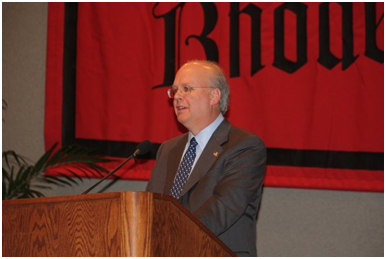 Last night I had the pleasure of seeing
 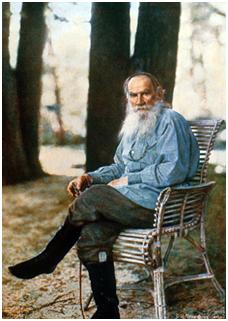 When I was growing up I had a hard-bound collection of collected works of L. N. Tolstoy on my bookshelf. They were bought by my mom, I think. At the time I did not care enough to read those books, something that later I regretted. The books, much like the rest of my home library, have been lost in the war. Many years later, once I was done with my MS and finally had more time for leisure reading, I started working on a reading list of books that I absolutely have to read. Tolstoy's "War and Peace" and Dostoyevsky's "Brothers Karamazov" had occupied the top two spots on the list. They are voluminous works that require many hours of dedicated reading attention, so although they were high on my list I had never been too quick to start reading them. The main reason, however, was not the length of those books. The main reason was that because those books were written in Russian I felt that a Croatian translation would do them much more justice than an English one. The language that these authors used was not too complicated, and almost any good translation into most of World languages would probably have done them justice. So over the years I had been tempted to abandon my desire for a Croatian translation. The temptation was particularly strong when I got my Kindle. The prospect of reading thick Russian books on a very slim and cool device was almost too strong, but in the end I had resisted the urge. Finally this winter during my trip to Croatia I made a concerted effort to track down "War and Peace" and "Brothers Karamazov." This turned out to be a much more challenging task than I had thought. The book selection in Croatian bookstore is rather paltry. Most of the bookstores are the size of café area at Borders of Barnes & Noble, so their offerings are severely restricted. Additionally, books in Croatia are extremely expensive, with even the simplest paperbacks selling for more than $25. Consequently, in a country where the purchasing power is well below that of the US, very few people buy books and bookstores are forced to sell mostly books that appeal to the widest possible audience. So, many classics of literature are out. For those one has to go to a specialty used-book store, which have become somewhat of a cultural icon in Zagreb. I didn't want get a used edition of the books I was looking for. I am a bit of a new-book snob, and besides if I had waited so long to read one of those books I wanted it to be a completely enjoyable experience.
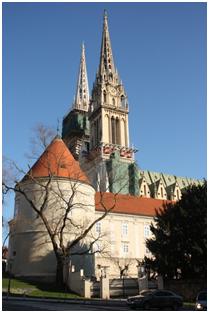 One of my favorite things to do when I go to Croatia is attend Mass there. The beauty of Mass is that it is (at least in roman rite) more or less the same wherever you go in the World, so I never feel completely like a stranger no matter where my travels may lead me. And yet, there are many differences, most of which could be easily lost on the outsiders. It has often been said that Catholic Church is much larger from the inside than from the outside, and this can be noticed by the way people approach Mass. In many ways Masses in Croatia seem more disorganized than the equivalent ones in the US – there are no ushers and greeters, no church bulletins, communion is handed out on the first-come-first-served basis, people line up for confessions while Mass is going on, and most Masses (unlike the rest of Europe) are standing-room only. However, all of this to me suggests a very vibrant and alive faith, faith that is treated seriously and with urgency that is in many ways lacking in other aspects of our lives. People there experience faith much more viscerally, and that cannot leave anyone indifferent. Throngs of believers that were lining up at the doors of the Franciscan Church in Mostar to get a glimpse of the Midnight Mass were not there out of some social obligation. They came because they truly believed, attending a church whose bare concrete walls still speak of the renovation that followed the total destruction in the war.
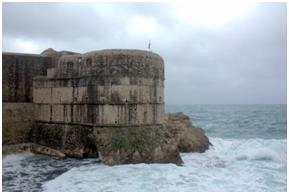 During one of our day trips, my brother and I visited Dubrovnik. It was supposed to be just a short visit, a few hours at the most. However, my brother got in touch with a friend who wanted to find an accommodation for us so we can spend the night. In the end she found us a room in a convent that was just down the street from the Old Town. This was practically a miracle, since Dubrovnik is one of the most expensive cities in the World (yes, the World) when it comes to the price of real estate, and stay in a hotel in that area would have cost us an arm and a leg. The nuns in convent were extremely hospitable, and immediately took to my niece. In the morning when we were supposed to leave they served us in the guest room with all sorts of most delicious Croatian pastries, and
 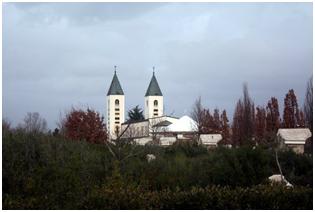 I also went with my brother and Vida to visit Međugorje. Usually, this is a very bustling city, filled with tourists and visitors from all around the World. This time, however, the whole town was practically empty. It was the Christmas day, and all shops were closed and everyone presumably wanted to spend this holiday surrounded with their family. Even so, we came across visitors from all over the place – Austria, Romania, Italy, Canada, etc. It brings to mind a truly universal reach of the Church, and in a very poignant way. Međugorje is located not too far from some of the places where just fifteen years ago ethnic hatred was the theme of the war that was tearing the whole region apart. It is good to have such a direct and visible reminder of the unity of human race, and how trite and silly those local conflicts can be in the big picture.
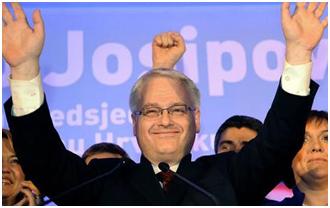 I have spent the better part of the past month in Croatia and Herzegovina, visiting my family. I haven't been there in a while, and I'll write more about my personal experiences when I get some free time in the upcoming days. One thing that I would like to remark upon right now, because it is still fairly fresh and relevant, are the presidential elections that just took place. Croatian politics is never boring, and these elections are no exception. In the second round Social Democrat